Showing posts with label veganism. Show all posts

Tuesday, February 18, 2014

Angela Davis @ Cal State Hayward (February 11, 2014)


https://archive.org/details/AngelaDavisCalStateHayward

excerpt:

"i do think that there is a connection between our eating practices…the question of food justice and the other social justice movements i invoked…as a matter of fact, it seems to me that the food justice movement has to be vey high on our agendas because so many people are dying because of their eating practices and don’t even realize it…we haven’t yet developed the kind of discourse that allows us to connect the…mcdonald’s and all the other fast food joints around here with the rise in diabetes, the rise of obesity, and all that…in many ways it’s really incredible, isn’t it?  and i think that food justice would also address the horrendous violence that is inflicted on animals for the purpose of producing food for human beings to consume.  there’s this amazing film, i think it’s called food inc.—i don’t see how anyone could ever eat a piece of chicken again after watching that film.  you see what is done to these beings…it’s linked to our struggles against racism, our struggles for the environment, and i do think this is going to be one of the top social justice issues of the future.”  angela davis

[previous mention of her veganism and then some!]


Wednesday, August 3, 2011

Decolonial Food For Thought...: Palabra on Indigenous Veganism

Decolonial Food For Thought...: Palabra on Indigenous Veganism: "What is the difference between Indigenous Veganism and Veganism? Primeramente, it is not the same. Indigenous Veganism is centered on the c..."

"This is a colonizers way of eating which takes from mother earth as it does by mass-producing toxic flesh grown in animal and fish farms by the millions and producing illusionary food products that are deemed necessary for our survival."

Thursday, July 7, 2011

A Crtique of Consumption-Centered Veganism


INTRODUCTION: The mainstream discourse and practice of veganism as an individual’s (abstention from) the consumption of animal products, I believe, is problematic in three interrelated ways: practicallyas an economic boycott,socially as a privileged consumerism, andphilosophically as an equivocation with a vegetarian lifestyle. I propose a new understanding of veganism as a social modality with and in regard to animal others which can be distinguished from and exist independently of vegetarian consumption. However, this distinction does not so much as invalidate vegetarian consumption so much as place it in a dialectic relationship with veganism, in which it can be regarded as a valuable means, but not an end.

PRACTICALLY, positioning veganism as an economic boycott is a very limited tactic given the prevalence of global capitalism. Mainstream veganism only addresses thecontent (i.e. animal products) and not the form/structure (i.e. capitalism) of the global market that facilitates the exploitation of animals as commodities and obstructs people from transforming society. This is evident in several ways.

First, many mainstream vegans tend to regard the very culprits of animal exploitation as the remedy. Veganism is now sold to people in the form of products (sometimes explicitly labeled “vegan”) by the very corporations (i.e. Kraft, Dean, Con-Agra, Burger King, etc.) that exist and profit off the exploitation of animals. While the availability and convenience of these products is celebrated as “victories,” their support only sediments the control these corporations have over the market and government. These agri-businesses that own, produce, and distribute most of our food supply have tremendous political power winning government subsidies and combating policy changes that would abolish animal exploitation practices..

Second, even if consumer vegans extend their boycott from the individual product consumed to the company who profits from it, without also challenging the present political-economic order of capitalism in which the interests of corporations persistently trump the interests of the general public, vegans remain complicit in the system that entitles businesses to exploit animal others (and human others as well). Besides, it’s not as if animal agribusiness is an isolated phenomenon; it is sustained by what Barbara Noske calls “the animal industrial complex”—an amalgamation of feed and chemical companies, the pharmaceutical industry, representatives and officers in government, public research and educational institutions etc. that are all mutually dependent upon one another through capital. Animal agribusiness will not be overthrown until these regimes and what gives them power are transformed. Even if consumer vegans were able to make significant dents in the national market, all this will be reversed by the rise of the affluent animal-eating class in the developing world to whom animals raised nationally will be exported, or—in “a race to the bottom”— to where the industry will be exported—displacing farmers and wildlife and externalizing production costs upon their communities.

Third, veganism as an economic boycott does not even universally enable people to practice veganism. Since wholesome food is regarded as a commodity rather than a socio-political right, large populations of disadvantaged people have little to no financial and/or market access to vegetarian food and goods, and thus are severely disadvantaged from living a secure vegan life. Food will continue to be grown for profits before people’s needs and preferences so long as food remains a commodity. A vegan world will not be brought about by the asocial, amoral market but by people in what Vandana Shiva calls “food democracy”—when food production and access is determined by people, not the imperialism of the market. In sum, mainstream vegan discourse and activism's focus on economic boycott is problematic primarily because, not because it is ineffective, but because it is insufficient. Without challenging the political, economic, and social structure of society, veganism as a movement will make little progress reducing and abolishing animal exploitation.


SOCIALLY, what is so troublesome about understanding veganism as primarily an abstention from the consumption of animal products is that it facilitates a number of objectionable social practices: self-righteousness, identity politics, militancy, colonialism, classism, and privileged consumerism. These objections to veganism, however, are not universal to all vegan practices. That veganism has been a medium for such unfavorable sociality is due to veganism being understood as a single-issue to which all other social movements are subordinated, backgrounded, or separated. Mainstream vegans like to practice veganism as only a matter of what people do to nonhuman animal bodies (i.e. whether they kill, consume, or exploit them) and insist that veganism has nothing to do with what people say or do to other people and their bodies. For instance, consumer vegans are often content calling their food or products “cruelty-free,” even as human animals are exploited and tormented during the production.

While I do think most mainstream vegans have very good intentions, the effects of some of their actions and discourse alienate potential allies. Many potential allies dismiss veganism as a middle-class white people’s pre-occupation with exercising their privilege through being humanitarians for “voiceless,” defenseless, and innocent animals without ever having to address their privilege that comes at the expense people of color and the working class. Examples of class privilege are popular vegan sound bites like “every time you sit down to eat, you can choose cruelty over compassion” and “vote with your dollars/fork.” In the former, one assumes one has any choice in what one eats. In the latter, consumption and purchasing power are equated with political power (and vice versa), which suggest those with less purchasing power do not (and cannot) exercise as much political power.

The consequences of this discourse becomes evident when mainstream vegans alienate people because they cannot afford to pay for dinner or a drink at a meetup, or when theyjudge others for using animal products they received for free in a precarious financial situation. (The same can be said about vegans traveling abroad and those who believe they must consume animal products for their health, like pregnant vegans). Mainstream vegan privilege leads some to interpret others’ imperfect vegan consumption habits as demonstrating a lack of commitment to animals, as not exercising personal moral responsibility. Although, “abolitionists” believe consumption-based veganism is the “moralbaseline”—the minimal obligation one has toward animals—, I wonder how often they assist underserved people achieve their “moral baseline” than judging them for failing to meet it on their own. If vegans are sincere about creating a vegan society, veganism ought to be a social space to which people are generously provided access. Veganism will have limited success so long as it remains a luxury reserved for those with privilege, independent of human liberation movements.


PHILOSOPHICALLY, when veganism is reduced to personal consumption or political action it becomes an instrument of morality rather than an ethics itself. If veganism is primarily a lifestyle that concerns nothing other than (an abstention from) consumption, then veganism is nothing more than a proper extension of or purification of vegetarianism: veganism is simply a vegetarian lifestyle. It logically follows that, if veganism is the moral baseline, that one’s consumption is the only qualification for being vegan, then one can very well be a speciesist vegan. This may sound peculiar because it is. The reason is that veganism is not merely a lifestyle or tactic, but a theoretical practice.

According to Ida Hammer, veganism is no “accident.” Veganism is a revolutionary praxis: “an anti-oppression framework that views the abolition of animal exploitation as part of a wider struggle for social justice” and “leads to a way of life (or lifestyle) that is based on noncooperation with, and divestment from, exploitation.”

Hammer’s liberation and anti-oppression discourse is notably different from Francione and Singer’s discourse on suffering and equality. While veganism, was “itself the principle, from which certain practices logically follow” for Leslie Cross, an original member of the Vegan Society, Francione “replaces veganism as the reason for these practices with what he calls ‘the rights position.’" Francione fails to recognize how the principles and rights he advocates have not even stopped humans from being oppressed. For instance, Afro-Americans may have been emancipated from slavery, however a new institution was created, the prison-industrial-complex, to place them back into bondage. Hammer explains that “[t]he property status of other animals… is just one piece of the structure of human supremacy, just as human slavery was just one piece of the structure of White supremacy.”

The theoretical discrepancies and historical failure of these principles can be traversed by focusing on renouncing human privilege and the corresponding institution of speciesism. “[S]ince speciesism is an ideology of oppression that legitimates the existing social order, we need to see veganism as a counter-ideology of liberation.” Removing the “-ism” from veganism, risks alienating veganism—an anti-oppression framework—from being a vegan, a “consumptive pattern that is increasingly self-interested and individualized” in contemporary discourse. Actions may "speak louder than words," but veganism cannot be reduced to one's (consumptive) actions alone.The fetishization of consumption practices misplaces the potential of veganism as a transformative social and ecological justice practice.

Hammer excellently articulates the problem of consumption-based vegan identity her latest essay, "Abolition, Liberation, and Veganism:"
[A]bolition in a negative sense is limited and destine for failure...we must also create a transformative shift towards non-exploitative institutions in order to achieved any sort of comprehensive abolition — institutions that are also socially and environmentally equitable...I'm talking about collective and institutional change on a structural level, not individual or consumer change. Adding animal-free alternatives to the already existing consumer market will not bring about comprehensive abolition. Comprehensive abolition will require revolutionary shifts in our existing social structures, which, I believe, would necessitate a restructuring of global economy away from exploitative, capitalist-based consumer markets. [my emphasis]


ADDENDUM: In this essay I alternate between critiquing consumer and consumption-based veganism. Although these are similar in that their focus is on market reform and individual lifestyle, they are not to be conflated. Many vegan critical theorists such as Bob Torres and Ida Hammer have critiqued the appropriation of the vegan movement by the logic of capitalist markets via corporations and even vegan companies (i.e. Veg News) and non-profits (i.e. PETA & HSUS). What I am arguing goes beyond this critique of consumerism and the structure of society that facilitates it. I am critiquing alsoveganism as an identity of consumption.

As I have previously explored, I would like to experiment with thinking about veganism as something more fundamental than abstaining from animal exploitation, as something affirmative about human-animal relationships that pre-conditions people's motivation to become vegan. In a future post, I would like to suggest, that we think about veganism without vegetarianism--which is not the same as advocating the killing or exploitation of animals. The point in doing so is to make a distinction for understanding the relationship between the two. Could someone practice veganism without being vegetarian? I think so. If this is the case, then we must understand veganism as something more and less than (vegetarian) consumption. Veganism would become fundamentally a social position or modality in regards to animal others, one in which we are bonded to them through attentive care, curiosity.

This is not to say vegetariaism is unimportant, only that it is unessential. Far from being trivial, vegetarianism is an invaluable performance especially as a critical praxis. If morality is post-hoc--"after the fact," a response to cognitive dissonance--, then a diet free of the consumption of animal bodies, their  labor, their products, and products tested on them is less likely to facilitate our rationalization of their exploitation. Vegetarian consumption practice facilitates a de-subjectification of a human identity based upon an opposition, negation, and domination of animality and animal others. Further, privileging vegetarian consumption over animal-based consumption enables the positive re-construction of our world away from one in which speciesism is institutionalized.

Therefore, I am not saying vegetarian consumption is impractical or supererogatory. Rather, vegetarainism consumption ought to be seen as distinguished from veganism--not as a logically defective kind as Francione would have it--, because vegetarian consumption and vegan social modality are in a dialectical relationship. In other words, a vegan modality motivates  vegetarian practice and vegetarian practice facilitates a maturer veganism. Vegetarianism is a means to the transformative practice that is veganism.


* NOTE: By "vegetarian consumption" I mean primarily a consumption practice free of all animal bodies and products, however, this critique applies also to lacto-ovo vegetarians.

Tuesday, February 22, 2011

For As Long As My Skin Is Black I Will Be A Devoted Anti-Speciesist. (repost from vegans of color)


 August 29, 2009

Filed under: Uncategorized — Royce @ 7:38 pm
Tags: 
The title of this post is a reference to the recent post at Womanist Musing. The post details her feelings about the ways animals have been used by a white supremacist society to metaphorize people of color. From the Black apes to the Latino chihuahuas and everything else  in between. I know those feelings all to well. The post ended with a powerful few lines:
They may scream biology until the end of time but we remember when such comparisons were used to justify slavery, rape, and segregation.  For as long as my skin is Black I will be a devoted speciesist.  My dignity and humanity demand no less.
Her words are haunting and powerful for me. And She’s right. Those memories run deep.  People of color still get their babies snatched away, still are shot and hunted, and until (maybe) recently experimented on. People of color are treated like animals, are called animals, and are dehumanized all the time.
In the US (and the world) Blackness positions people at the bottom of a very real racial hierarchy. Solidarity between different people of color is sometimes hard as we all scramble to get ourselves away from the bottom. Some of us do this by distancing ourselves from the bottom, from Blackness. I have heard people of color who aren’t Black distance themselves by how different they are from Black people. Black people distance ourselves from each other through colorism and regionalism/xenophobia. I’ve heard American Black folks distance themselves from African Black folks through primitivist, xenophobic rants. And Black Africans distancing themselves because Black Americans are portrayed as violent and animalistic.
I can’t ask a cow about her feelings on her systematic and mechanical rape, separation from her child, and eventual slaughter. But to assume because of differences between us that she doesn’t care, or is incapable of care uses the same logic as white supremacy has used for people of color.
Koko, the famous gorilla, could sign 6,000 signs. She could create new words by combining signs. She scored between 70 and 95 on IQ tests. She makes me think of Red Peter. Red Peter is the only Kafka character to have really, truly touched me. A Report to An Academy resonates with my diasporic identity. To be snatched from home, shipped to somewhere else, and lose one’s connection to home, but to be able to speak back to the one who took you in their own tongue. Is it such a stretch to think that animals could not also be upset by being shipped in cages across oceans but be unable to tell us such in a language we can understand.
Red Peter was a link for me. He is literally a gorilla, metaphorically a diasporic person. He’s the missing link between Koko and animal and me a human. If I can empathize with a literary gorilla who tells the same story as Koko might tell, than I can also empathize with Koko, and by extension all animals.
In my soul I know it would be just as wrong for me to withdraw my solidarity to those who are seen as less than me, because of a species barrier. To construct the worth of a being by their humanness is an embrace of a world where white patriarchy is the standard. Humanness is so connected to  able-bodiedness, whiteness, maleness, cisness, straightness, because these were the people who got to decide who got to count, and when they got to count as human.
For me to use biology to explain why it isn’t ok to kill or cage me, but it is to kill or cage someone else is a replication of power dynamics. It is shitting on those lower than me on a hierarchy of power, so that I can keep my perch away from the bottom.
For me to refuse compassion to other beings, simply because I have been compared to them, is to center whiteness. I say “Fuck you!” to those white folks who think they have the authority to use my history to humanize animals. But when it is just me and the caged bird I know what’s up, I don’t need to compare. My histories let me empathize in a way I doubt those in the center ever could.
I’ve reached a different conclusion from Womanist Musings: a history of my people being kidnapped, enslaved, caged, experimented on, hunted, sacrificed, killed, and displayed has left a bad taste in my mouth, and empathy in my heart.
For as long as my skin is Black I will be a devoted anti-speciesist.


source

Monday, December 6, 2010

Mike Tyson A Totally Committed Vegan, Won't "Cheat" For Favorite Foods


Mike Tyson Credits Vegan Diet With Massive 130 Pound Weight Loss

Earlier this year, Ecorazzi reported that (much to our surprise) Mike Tyson had changed his life in some pretty big ways, including going vegan. Well, the famous boxer continues to preach about his new lifestyle, and recently sat down with ESPN to share the secret to his 130 pound weight loss.
“I became a vegan,” says Tyson. “Vegan is where no animal products. No livestock products. Nothing. I just did a lot of training and try to become more faithful in life. I wanted a different life. I felt like I was dying. I had an incident in life where I lost my 4 year old daughter in a tragic accident at home. I don’t know. I didn’t want to live anymore. So I said, that in order to go there, I had to change my life. I am going to change everything I dislike about myself. I changed everything that I was as a human being. I started that journey in October or November. … I don’t smoke anymore. I wanted to give up everything. I had to change my life. I didn’t have a problem with drugs or nothing. I had a problem with thinking. My thinking was broken. That was the solution of my broken thinking using drugs and living crazy. It was just the way I was thinking.”
Tyson has been vegan for almost a year, and, of course, we’re excited that’s he’s loving the lean, green diet. Do you have an amazing vegan weight loss story? Comment below and share it with us!

Monday, November 29, 2010

Reproductive Autonomy: Crossing the Species Border By Helen Matthews


Reproductive Autonomy: Crossing the Species Border
By Helen Matthews


Leon and Cat
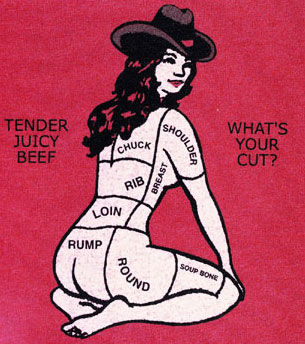
From Matthew’s online slideshow: This picture, titled Break the Dull Beef Habit, which was on a t-shirt sold at Urban Outfitters, juxtaposes the fragmentation of women’s and animals’ bodies.
If we are serious about animal liberation, then we must work for the liberation of all animals, human and nonhuman. If we are serious about feminism, then we must shun speciesism just as we shun sexism. No one is free while others are oppressed. And, if we work together, understanding how seemingly different struggles are related to one another, then someday we will all be free.—Pattrice Jones

The first chilling moment of awareness I had about the connection between feminism and animal liberation occurred back when I was 15, sitting on the porch with my family about to eat dinner. My dad had barbecued a chicken and it was sitting in the middle of the table. I was looking at it and thinking about the colors, the dark brown and the black. I was thinking it looked burnt, just like burnt skin. I realized that it actually was burnt skin, it wasn’t just resemblance, it was a burnt body. That was when I said, “I’m not eating any dinner, I’m not eating that. I’m gonna be a vegetarian.”

That bird, I thought, was conscious once—was once animated with life. Now it was just the centerpiece of a meal. Parts of this once-living bird would even wind up in the trash. In that moment, this collapse—this reduction—became so vivid to me.

I think the reduction of “someone to something,” as Carol Adams puts it, is at the core of most violence against other animals. To reduce other animals to things usually means treating their bodies as resources for something you need, manipulating them while they’re alive and/or killing them. I think the way humans are constantly interfering with the bodily autonomy of other animals closely resembles the way males often subordinate females—controlling the body, which is our physical home in the world, our place, and (in a lot of ways) our sense of self. (I guess this is because both forms of domination happen under the umbrella of human-centered “white-supremacist capitalist patriarchy,” to use bell hooks’ analysis.) Control over the bodies of animals and human females is carried out through specific systems of domination such as sexual objectification in popular imagery, abuse in homes, labor exploitation, linguistic stereotyping, and reproductive control.

The High-heel Dichotomy 
But who are “women,” anyway? This question seems to be the—or one of the—primary issues of feminist theory. Definitions that I’m familiar with refer to a set of character and anatomical traits, political conditions, and fashion statements. But popular definitions of who women are don’t allow for much transformation out of, into, or within “womanhood,” so they can feel as painfully restrictive as a pair of high-heels or a tiny skirt that you desperately try to fit into. Not wanting to perpetuate a reductive definition of “women,” I’m just speaking of people with uteruses and ovaries and the various reproductive organs of the female sex.

For human females, reproductive control comes in the form of anti-abortion legislation, the financial inaccessibility of contraceptives through health care plans, the scarcity of abortion providers (particularly affordable ones), the illegalization of many contraceptives, “right-to-know” laws, and intimidation from anti-abortionists. According to the Abortion Access Project, 87 percent of all U.S. counties have no abortion provider. Between 1982 and 2003, they report that the number of abortion providers decreased by 37 percent. The majority of U.S. states have parental involvement laws. And over half of all abortion providers were harassed in 2000, and countless more women are intimidated by protesters just for entering a clinic, even for a regular check-up.

In the face of all of this, the media, our schools, our families, churches, workplaces and communities instruct females in various contradictory ways about our sexuality, ranging from the mandate to be celibate to the injunction to be accessible sexual objects for males. So many demands: we’re supposed to be sexually available (even objects of rape) but also chaste, we’re denied adequate contraception from our health care plans and yet are supposed to remain unfertilized. These messages vary according to race and class and physical ability and many other factors of identity. I’m a white, financially stable, 20-something female from the South. Still, from what I’ve seen in my life, I’d bet that these contradictory, confusing messages (which feminists often call the “virgin/whore dichotomy”) are familiar (on some level) to most females in this country.

African American women seem to be especially frequent subjects of public debate about reproductive control. The debates around welfare reform, for instance, particularly during the time of the 1996 Welfare Reform Act, called up this hostility toward women’s reproduction, especially toward African American pregnancies, which became the imagined national problem in need of a solution. Problematizing African American women’s sexuality is an old patriarchal construct: the hypersexual “black female savage” is out of control and must be restrained, as feminist writers like bell hooks have explained. But history exposes the irony of the stereotype: white male slave owners used enslaved women as “breeders” to produce more slaves. Quoted in an interview, one formerly enslaved woman said she “brought in chillun ev’y twelve mont’s jes lak a cow bringing in a calf.”

The Reproduction Farm
A few years ago I went to a big conference on reproductive control at Hampshire College. One of the opening speakers, Mina Trudeau, boldly challenged the audience to think about how reproductive control affects other species. For so many cows, chickens, dogs, minks, and other nonhuman animals, the lack of reproductive autonomy is a guaranteed part of existence.

Consider farmed pigs. As David Wolfson writes in Beyond the Law: Agribusiness and the Systematic Abuse of Animals Raised for Food Production, “gestating (pregnant) sows and farrowing (birthing) sows are housed in stalls where they are unable to turn around (gestation crates or farrowing crates). Such intensive farming practices result in health problems, including lameness or high death losses” Gestation crates apparently prevent sows from accidentally rolling or stepping on their piglets and make their teats available during lactation.

Cows’ reproductive systems are the foundation of the milk industry. Gene Bauston, the founder of a large sanctuary for farmed animals, says:
“All cows, whether they live on dry-lot dairy factories in the Southwest or small traditional dairies in the Midwest or Northeast, must give birth in order to begin producing milk. Today, dairy cows are forced to have a calf every year because such a schedule results in maximized milk production and profit. Like human beings, the cow’s gestation period is nine months long, so giving birth every 12 months is physically taxing. The cows’ bodies are further taxed as they are forced to give milk during seven months of their nine-month gestation…it is not uncommon for dairy cows to produce 100 pounds of milk a day—ten times more than they would produce in nature.”

According to Bauston, producing so much milk can cause several common physical ailments. One is mastitis, inflammation of the udder. In 1996, about half of dairy cows in the U.S. suffered from mastitis. Dairy cows also develop ketosis, a metabolic disorder, and laminitis, which leads to lameness. Also common are Bovine Leukemia Virus, Bovine Immunodeficiency Virus, and Johne’s disease.

Chicken bodies are also captive resources of industrial agriculture. Egg laying hens are subjected to forced molting in factory farming complexes, meaning that light, food and water are withheld for up to 14 days in order to control egg output. This serves to “shock their bodies into another egg-laying cycle,” as Bauston says.

Other domesticated animals, like dogs, are also reproductively manipulated. Joan Dunayer in her book Animal Equality points to an article in the American Kennel Club’s magazine that “recommends ‘holding the bitch in the proper position,’ with straps or by her legs, and ‘assist[ing]’ the male in ‘penetration.’”

Like farmed and companion animals, lab animals also are bred for mass production. The degradation of these sentient creatures is most evident in lab animal industry catalogues where they are often sold for a price per “unit.”

Horses are used to produce the estrogen replacement drug Premarin (named after its source, PREgnant MARes’ urINe). Manufacturing Premarin involves taking the urine from pregnant horses and the mares are routinely impregnated for this purpose. The animal advocacy group United Animal Nations says, “Premarin mares are confined to small stalls for months on end while their urine is collected and…their foals are herded off to slaughter every year to be sold to European meat markets.” Thousands of mares are basically immobilized in these stalls, and in the winter, as one concerned activist explains, “you see ice on the walls [of the barns], and they have to lay down on cold, ice-cold concrete floors.” Constant forced impregnation of these horses is necessary for the production of Premarin. Ironically, Premarin manufacturers exploit the reproductive systems of horses to market their product to menopausal women.

The Worn and Weary
When reproductive exhaustion has finally worn their bodies down, many animals are killed, especially those in agribusiness. No longer able to produce milk, dairy cows, for example, are killed for meat. Farmers send them to slaughter after they’ve lived only a small fraction of their lives. Sometimes they literally become trash, since their meat is usually “low grade” and used in junk food that often winds up half-eaten in a dumpster.

The fight for liberation from reproductive domination isn’t just a human struggle, although many feminists construe it this way. Similarly, if animal liberationists really want to end the oppression of other animals, we’ll have to understand how that oppression is mirrored in the daily experiences of human females. Reproductive autonomy is a need that cuts across species barriers. It is a solid and heavy example of the overall lack of bodily integrity that both human females and other animals endure.

Helen Matthews, a.k.a. Homefries, has been working on connecting social justice and animal liberation issues for five years. She has worked with Boston Ecofeminist Action, and facilitates workshops on feminism and animal liberation at conferences, community centers and universities around the country. Check out her online slideshow atwww.smartelectronix.com/~marc/rtso.

Tuesday, November 23, 2010

PATTRICE JONES -- FEMINIST FUSION

Pattrice Jones (click link for full interview)


"It wasn't until I was researching the psycho-history of racism, which led me to investigate the origins of sexism, that I discovered the underground connections between human exploitation of other animals and the various kinds of exploitation that exist among human animals."

Wednesday, November 17, 2010

PCRM >> Health >> Fish Report 2009


Report


Fish
Few food products are as controversial as fish. A leading source of heavy metals and other contaminants, fish is frequently the subject of government health-risk advisories. However, some people promote fish as a source of omega-3 fatty acids. Let’s look at the issues.

Understanding Mercury

Mercury accumulates in aquatic life, concentrating especially in large predatory fish. Of the potential sources of mercury contamination, the consumption of fish and shellfish contributes most to the mercury concentration in humans.1
Nearly all fish contain traces of mercury. Some fish and shellfish tend to contain higher levels, either because they live in more contaminated waters or because they are larger carnivores consuming many contaminated smaller fish. Because mercury is eliminated slowly from the body, it may build to very high levels in the systems of animals—including humans—that consume it.
Levels of contamination vary widely from place to place and even among individual fish. Therefore, even well-informed consumers have no way of knowing whether the fish they have purchased has a high or low level of mercury contamination. Even modest consumption of moderately contaminated and commonly eaten fish can put consumers at risk very quickly.2

Effects of Mercury Contamination

Mercury exposure has been linked to a wide variety of ills, including acute and chronic effects on the cardiovascular and central nervous systems. Also, the Environmental Protection Agency (EPA) and the International Agency for Research on Cancer (IARC) have designated mercury as a possible human carcinogen.1

Mercury and the Heart

Mercury accumulates in the heart, as well as other tissues, and has been associated with increased blood pressure, irregular and increased heart rate, and increased rates of death from cardiovascular disease in at least 12 scientific studies.1
Consumption of fish and omega-3 fatty acids, including docosahexaenonic acid and eicosapentaenoic acid, has been associated with decreased risk of heart attack in individuals consuming a Western-style diet.3,4 However, three recent studies have shown that mercury exposure may have the opposite effect. In one study, mercury levels were 15 percent higher among those patients who had suffered a first heart attack.5 A second study showed increased risk of cardiovascular mortality with increasing mercury exposure.6 The third study found that a high content of mercury in hair may be a risk factor for acute coronary events, cardiovascular disease, coronary heart disease, and all-cause mortality in middleaged men. This study also found that mercury may negate the purported protective effects of fish on heart health.7

Other Pollutants in Fish

There are several other pollutants that accumulate in fish and shellfish. Taken together, polychlorinated biphenyls (PCBs), dioxin, chlordane, DDT, and mercury account for 98 percent of all fish advisories issued in 2004.8 Many other toxins, including other heavy metals and organochlorine pesticides, find their way into water and aquatic life as well.
These pollutants are toxic to humans, fish, and other animals that consume and bioaccumulate them. Many of these chemicals are especially problematic because they are not readily cleared from the body and accumulate over a lifetime. Thus, even if exposure is limited to a discrete period of time, the potential risks persist.
According to the EPA, PCBs are known carcinogens in some species and probable carcinogens in humans. PCBs also have been shown to disrupt immune function, cause learning disabilities, and disrupt neurological development; they may have endocrine effects as well.
Dioxins, too, are known carcinogens and have also been shown to cause liver damage, weight loss, skin rashes, and reductions in immune function.9 They are especially dangerous during fetal development and early childhood.10
Chlordane and DDT, an organochlorine, are pesticides that have been banned from use in the United States. Nonetheless, appreciable levels of these highly toxic chemicals remain in waterways and bioaccumulate in fish.11

Nutrient Composition of Fish

Like other meats, fish are especially dense in animal protein (15 to 20 grams in a three-ounce cooked portion). People in the United States already consume well above the daily value for protein (50 to 65 grams). Protein intake averages about 15 percent of total calories, for a mean intake of approximately 100 grams per day for men and 70 grams per day for women.12 Much of this protein comes from animal sources.
Diets containing excessive protein are associated with increased risk of impaired renal function,13 osteoporosis,14 and complications of diabetes.15 Promotion of fish products may increase protein intake and aggravate these risks.
Furthermore, increasing fish intake would likely increase total fat and saturated fat intake. Although some of the fat in fish is in the omega-3 form, much of the remaining fat is saturated. Chinook salmon, for example, derives 52 percent of its calories from fat, and swordfish derives 30 percent. About one-quarter of the fat in both types of fish is saturated. Fish and shellfish are also significant sources of cholesterol. Three ounces of shrimp have 166 milligrams of cholesterol, while the same amount of bass has about 80 milligrams; in comparison, a 3-ounce steak has about 80 milligrams.16

Other Health Risks

There may be specific risks to fish consumption as well. For example, a 2004 study looked at diet and prostate cancer in Japanese men. It showed that a high consumption of fish was significantly associated with prostate cancer risk.17
In a comprehensive review, the Center for Science in the Public Interest determined that fish and shellfish dishes caused more foodborne illness outbreaks than any other food between 1990 and 2003.18 Such outbreaks can result from bacterial or viral contamination or from naturally occurring toxins. These naturally occurring toxins are not destroyed by cooking.19

A Healthier Way to Beat Heart Disease

Fish is often touted for its possible benefits relating to heart disease. However, it is already known that vegetarian diets help prevent, and even reverse, heart disease. Animal products are the main source of saturated fat and the only source of cholesterol in the diet. Vegetarians avoid these risky products. Additionally, fiber helps reduce cholesterol levels20 and animal products contain no fiber. When individuals switch to a high-fiber, low-fat diet, their serum cholesterol levels often drop dramatically.21,22 Studies have demonstrated that a low-fat, high-fiber, vegetarian or vegan diet combined with stress reduction techniques, smoking cessation, and exercise, or combined with prudent drug intervention, could actually reverse atherosclerosis—hardening of the arteries.23,24

Safer Sources of Omega-3 Fatty Acids

High levels of toxins, fat, and cholesterol and a lack of fiber make fish a poor dietary choice. Fish oils have been popularized as a panacea against everything from heart problems to arthritis. In fact, fish oil supplementation may increase the risk of cardiac arrhythmias in some patients, specifically those who require a pacemaker for this problem.25 Research has shown that omega-3s are found in a more stable form in vegetables, fruits, and beans.26,27
Alpha-linolenic acid, the only essential omega-3 fatty acid, is found in many vegetables, beans, nuts, seeds, and fruits. It is concentrated in flaxseeds and flaxseed oil and also found in oils such as canola, soybean, walnut, and wheat germ. Omega-3 fatty acids can be found in nuts, seeds, and soy products, as well as beans, vegetables, and whole grains.28,29 Corn, safflower, sunflower, and cottonseed oils are generally low in omega-3s. Fish consumption is by no means the only way to ensure adequate intake of omega-3 fatty acids.

Conclusion

Given the clear evidence that fish are commonly contaminated with toxins that have well-known and irreversible damaging effects on children and adults, the consumption of fish should not be encouraged. The risks are known and, especially for infants and women of childbearing age, significant. The other risks associated with the consumption of fish and shellfish, which are high in animal protein and often saturated fat and cholesterol, are also considerable. It is best to avoid the consumption of fish and shellfish. Other, more healthful foods from plant sources offer the full range of essential nutrients without the toxins and other health risks in fish.

References


Related Posts Plugin for WordPress, Blogger...